
Deconstructing the Monolith: A Guide to Microservices for Full-Stack Developers
Transitioning from monolithic architecture to microservices using API Gateways, isolated databases, and Docker. A practical system design guide for scalable enterprise delivery.
The Ceiling of Monolithic Architecture
When building an MVP or a standard client web application, a monolithic architecture—where the frontend, backend, and database logic are tightly coupled—is incredibly efficient. However, as user traffic surges, monolithic structures reveal a fatal flaw: you cannot scale individual features. If your payment processing module is overwhelmed, you are forced to duplicate and scale the entire application, wasting massive server resources.
Enter Microservices: The Enterprise Standard
To build platforms capable of handling global traffic, engineering teams must decouple their codebases. Here is how modern Microservices architecture solves the scaling problem:
1. Decoupled Services
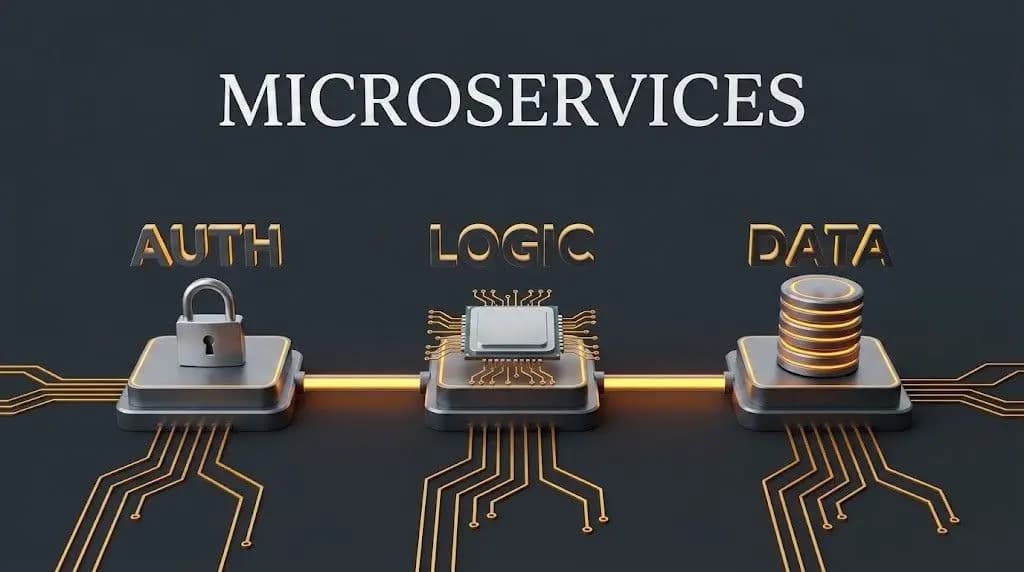
Instead of one massive Express.js backend, the application is split into independent services (e.g., Auth Service, Logic Service, Data Service). Each service can be written in the best language for the job and scaled completely independently using Docker containers.
2. Centralized API Gateways
With multiple backend services, client applications (like your Next.js frontend or React Native mobile app) shouldn't talk to them directly. An API Gateway acts as the single entry point, routing requests securely to the correct internal microservice, handling rate limiting, and managing SSL termination.
3. Isolated Databases
In a true microservices architecture, services do not share a single massive database. The Auth service might use Redis for fast session storage, while the User Data service uses MongoDB. This prevents database locking and ensures one failing service doesn't bring down the entire platform.
Ready to Scale Your Architecture?
Understanding system design is what separates standard developers from technical architects. If your business needs a highly scalable, enterprise-grade custom CRM, web platform, or mobile application, let's build something robust.
Connect with me to discuss custom enterprise software development: Contact Ashwani