

Scaling Full-Stack Apps: The Journey to Enterprise CI/CD, Docker, and Microservices
Discover why moving from manual deployments to automated CI/CD pipelines, Docker containerization, and microservices is the key to building secure, scalable, enterprise-grade software architecture.
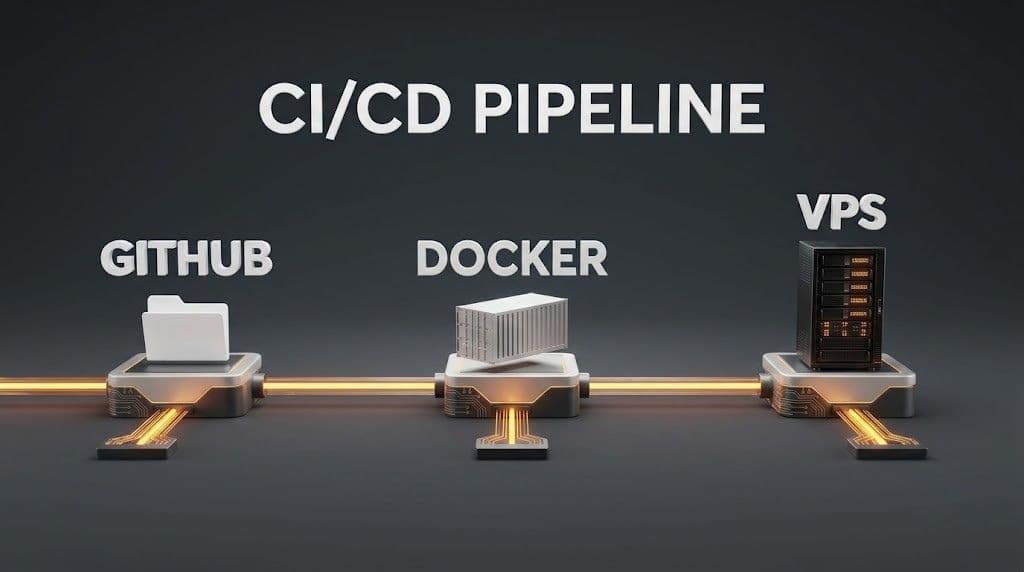
The Milestone: Automating the Bare-Metal VPS I recently hit a major milestone in my full-stack engineering journey: completely automating the CI/CD pipeline for my personal web platform. By leveraging GitHub Actions, PM2, and a bare-metal VPS, I transformed a tedious manual deployment process into a seamless, automated workflow. Now, every push to the main branch is built, tested, and deployed without a single manual server login.
But in the world of professional software engineering, getting code to simply "work" is just step one.
Whether you are delivering custom solutions to high-value freelance clients or engineering platforms for tech giants, building robust, secure, and infinitely scalable systems is the ultimate goal. That is why I am actively transitioning my focus toward the exact architectural standards used by industry leaders.
Here is the roadmap I am following to elevate my engineering stack from standard web applications to enterprise-grade architecture.
🐳 Phase 1: Docker & Containerization Every developer knows the dread of the classic "it works on my machine" problem. Differences in operating systems, Node versions, and local database configurations can cause deployments to fail in production.
To eliminate this, my immediate focus is on containerization. I am currently working on packaging my MERN stack applications into isolated, ship-ready Docker containers. By defining the exact environment within a Dockerfile and orchestrating it with Docker Compose, I can ensure flawless execution across any server environment—be it a local development machine, a client's private server, or an AWS EC2 instance.
🧩 Phase 2: Modern Microservices Architecture Monolithic structures are great for getting a product off the ground quickly, but they create massive bottlenecks when an application needs to scale. When one feature requires more CPU, you are forced to scale the entire application.
To build systems capable of handling massive user loads, I am diving deep into modern microservices architecture. This involves:
-
Decoupling Services: Breaking down the backend into independent services (e.g., Auth, Payments, Data Processing).
-
API Gateways: Implementing a central routing layer to manage incoming traffic securely and efficiently.
-
Independent Databases: Isolating databases so that high-traffic services don't lock up data required by other parts of the application.
Aligning with Enterprise Tech Standards As a Full-Stack Developer, my primary focus is engineering high-performance, secure architectures. I am incredibly excited to integrate these advanced DevOps practices into my daily workflow.
Mastering these concepts doesn't just make deploying code easier; it builds the foundational knowledge required to architect platforms that meet the rigorous security and scalability standards set by global tech giants like Google, Microsoft, Amazon Web Services (AWS), Oracle, and IBM.
Join the Conversation To the engineering managers, technical recruiters, and DevOps experts reading this: When you are hiring full-stack engineers or evaluating freelance technical architects, what is the one system design skill you believe separates a good developer from a truly great one?
Let's connect and discuss on LinkedIn!