All insights
MongoDB vs MySQL: Which Database Should You Use for Your Web App?
MongoDB vs MySQL compared for real projects: data model, schema flexibility, relationships, transactions, scaling, and which fits CRMs, e-commerce, and SaaS apps.
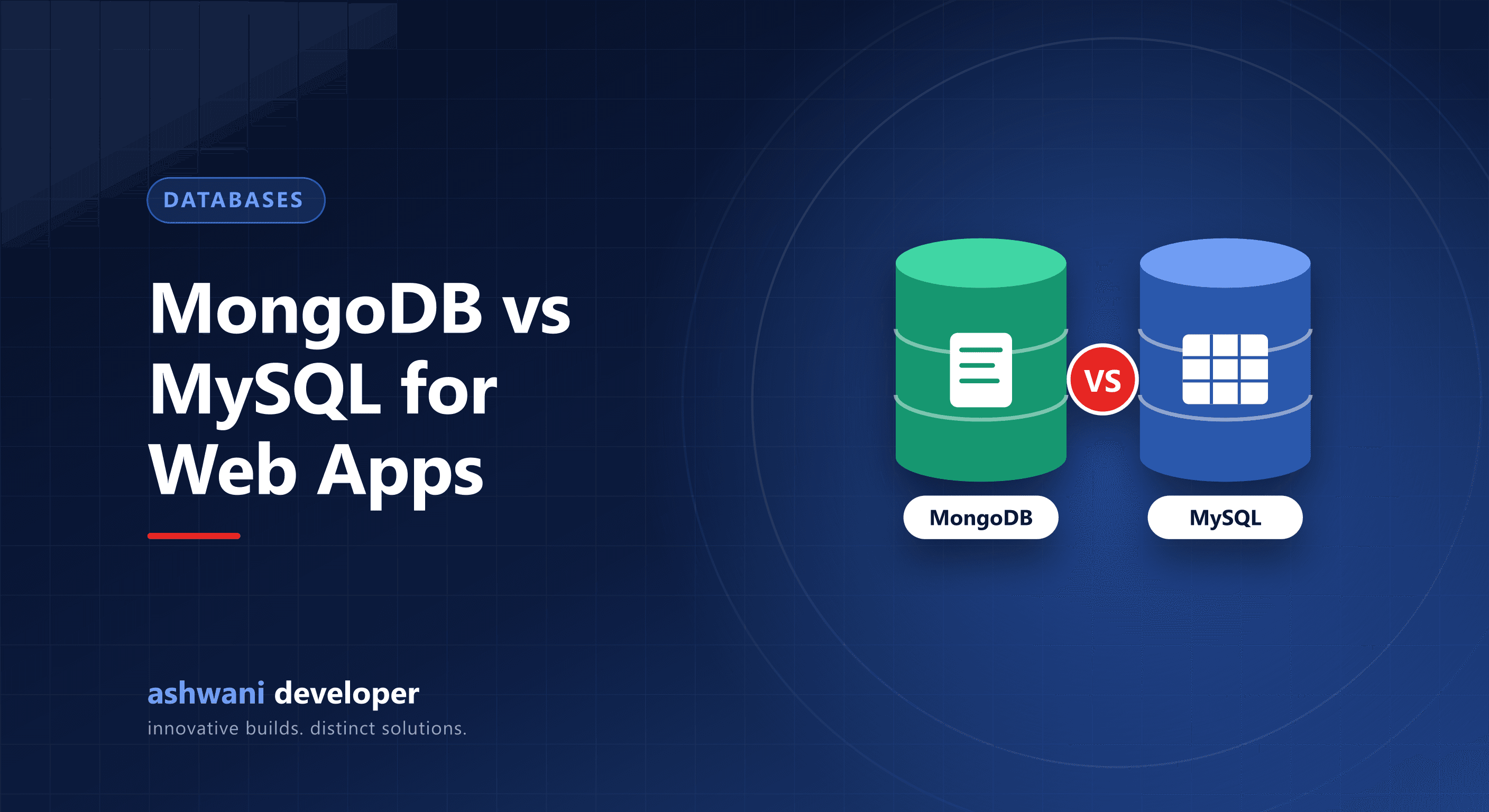
Quick answer: MySQL is a relational database with tables, fixed schemas, and strong support for joins and complex transactions, making it ideal for highly relational data such as accounting and inventory. MongoDB stores flexible JSON-like documents, making it fast to develop with and a natural fit for evolving products, content, and nested data. Both are mature and production-ready.
Data model
MySQL organises data into tables with rows and columns. Relationships are expressed with foreign keys and queried with joins.
MongoDB stores documents in collections. A document can contain nested objects and arrays, so related data that is read together can live together.
Comparison
| Factor | MySQL | MongoDB |
|---|---|---|
| Structure | Tables, fixed schema | Documents, flexible schema |
| Relationships | Joins, foreign keys | Embedding or references, $lookup |
| Transactions | Mature multi-table transactions | Multi-document transactions supported |
| Schema changes | Migrations required | Fields can evolve; validation optional |
| Query language | SQL | MongoDB query API and aggregation |
| Horizontal scaling | Possible, more setup | Built-in sharding |
| Natural fit | Finance, inventory, reporting-heavy systems | Content, catalogues, user data, rapid iteration |
Choose MySQL (or PostgreSQL) when
- Data is highly relational with many many-to-many relationships.
- Correctness of complex transactions is critical, such as ledgers or stock movements.
- Reporting relies on ad-hoc SQL queries across many tables.
- Your team or existing systems already use SQL.
Choose MongoDB when
- Your data structure is still evolving as the product grows.
- Records have nested or variable fields, such as product attributes or form submissions.
- You want one JavaScript-friendly model across front end, API, and database, as in the MERN stack.
- You need to scale reads and writes horizontally.
Common myths
- "MongoDB has no schema": it supports schema validation, and well-built apps define schemas in code, for example with Mongoose.
- "MongoDB cannot do transactions": multi-document ACID transactions are supported.
- "SQL does not scale": relational databases power some of the largest systems in the world.
Real-world examples
- CRM: both work. MongoDB suits flexible custom fields; SQL suits heavy cross-entity reporting. Track Time CRM runs on MongoDB.
- E-commerce: catalogues fit documents well; orders and payments benefit from strong transactions in either.
- Accounting or ERP: relational databases are usually the safer default.
What matters more than the choice
Good indexes, sensible data modelling, backups, access control, and monitoring matter more than which database you pick. Poor design causes problems in either.
Planning a web app? See web application development or describe your data for a recommendation. Related: Node.js vs Laravel.