React Native vs Flutter for a Business App in India: Which Should You Pick?
React Native or Flutter for your business app? Compare performance, hiring, cost, code reuse, and long-term maintenance to choose the right cross-platform framework.
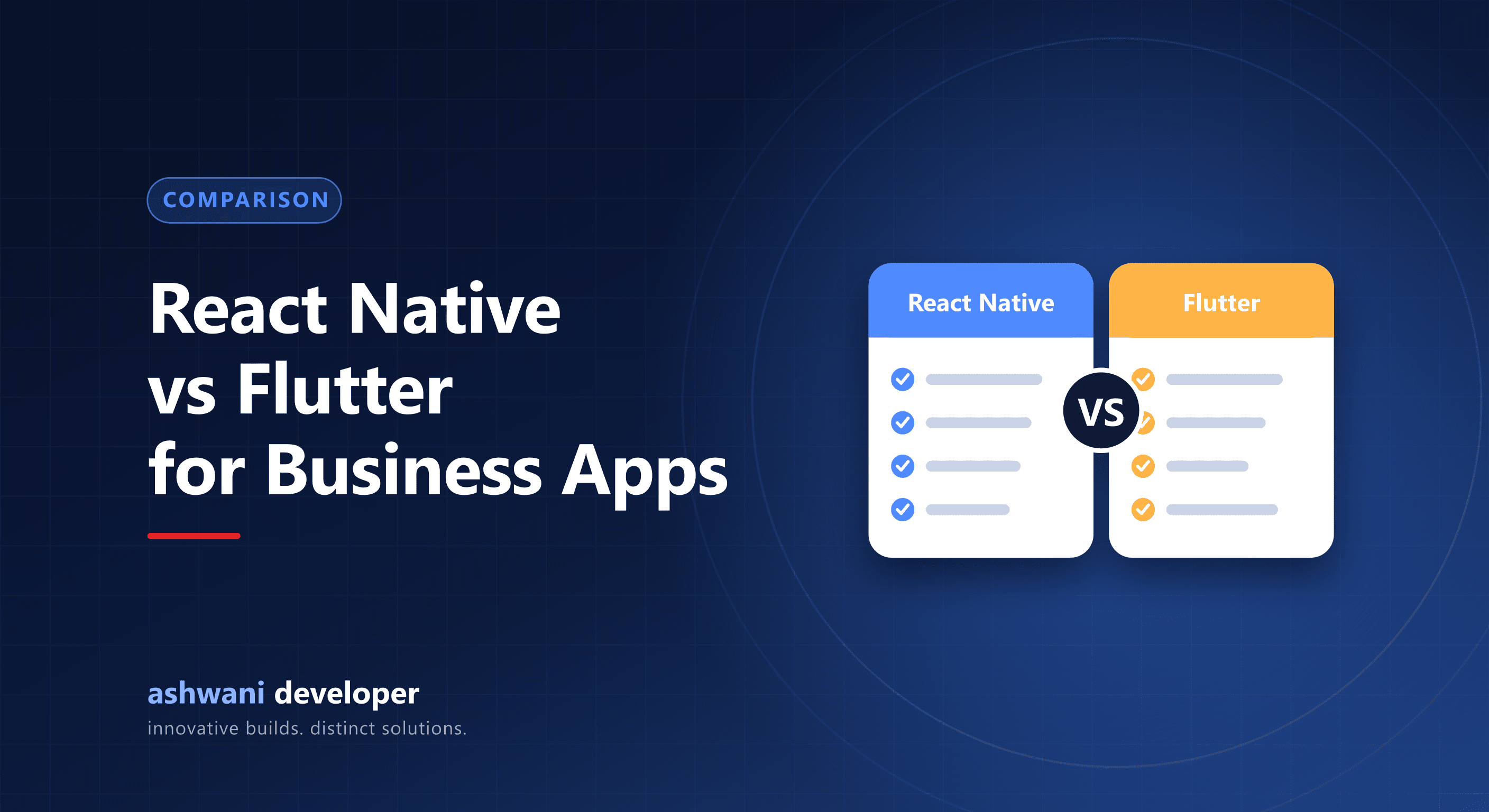
If you want a mobile app on both Android and iOS without paying for two separate builds, the two leading options are React Native and Flutter. Both are mature, both are used in production by large companies, and both can produce a polished app. The right choice depends on your team, your product, and your plans. This is a practical comparison, not a tribal argument.
The short version
- React Native uses JavaScript or TypeScript and React. It suits teams that already work with web technology.
- Flutter uses the Dart language and draws its own interface. It suits products where a highly custom, pixel-consistent UI is the priority.
Language and learning curve
React Native builds on JavaScript, the most widely known language among web developers. If your website and backend already use JavaScript or Node.js, the same people can share knowledge, code, and tooling across web, API, and mobile. Flutter requires Dart, which is easy to learn but a smaller talent pool in most Indian cities.
Performance
Both frameworks deliver smooth performance for the vast majority of business apps: forms, lists, dashboards, maps, chat, and payments. Flutter's own rendering engine is an advantage for animation-heavy interfaces, while React Native's modern architecture renders with native components and has closed most of the historical performance gap. Heavy 3D games and extremely demanding graphics are better served by fully native tools.
Look and feel
React Native uses each platform's native components, so apps feel familiar on Android and iOS. Flutter renders its own components, which gives identical visuals on every device but can feel slightly different from the platform unless it is tuned.
Ecosystem and integrations
React Native benefits from the huge JavaScript package ecosystem and a large community. Flutter's package ecosystem is strong and growing. For common needs such as authentication, push notifications, payments, maps, and analytics, both have well-supported options, and either may need a small native module for something unusual.
Cost and maintenance
The biggest cost saving comes from sharing one codebase across platforms, and both frameworks deliver that. Ongoing cost is driven by how easy it is to find developers and how much code you can share with your web product. Where the web side is already JavaScript or React, React Native usually reduces long-term cost.
When to choose React Native
- Your team or backend already uses JavaScript, TypeScript, React, or Node.js.
- You want to share logic between web and mobile.
- You value a large hiring pool and a mature ecosystem.
When to choose Flutter
- You need a heavily branded, animation-rich interface that looks identical everywhere.
- Your team is comfortable with Dart or willing to invest in it.
- You plan to target mobile, web, and desktop from one UI codebase.
Do not forget the backend
Whichever framework you choose, the app is only as reliable as the API behind it. Authentication, data storage, payments, and notifications need a secure, scalable backend, designed together with the app. Read about the full path in the mobile app development process.
For most business apps where speed to market and maintainability matter, React Native is the pragmatic choice, and it is the framework used for most projects on the app development service page. If you are unsure which suits your idea, share a short brief and you will get a direct recommendation.