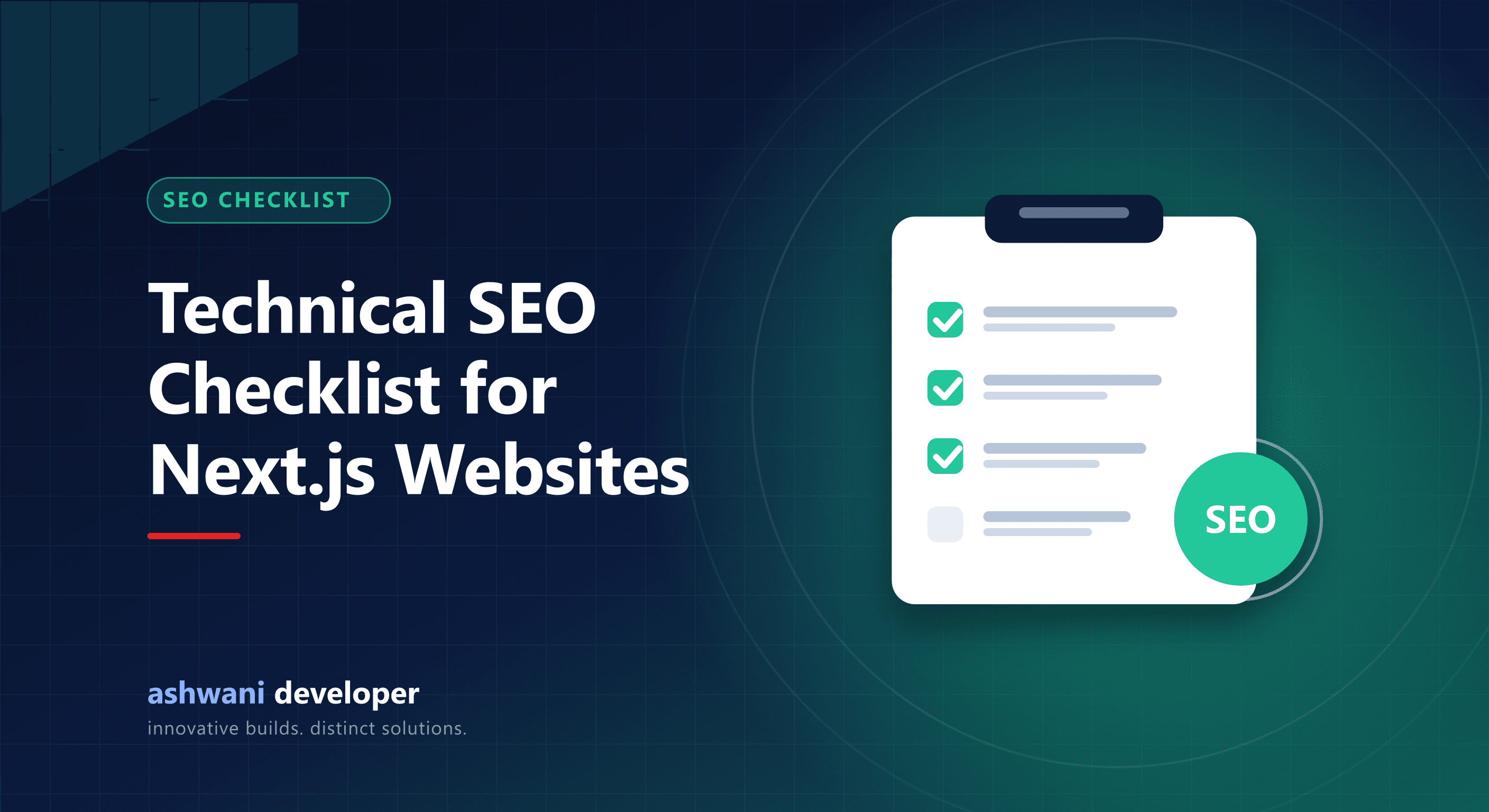
Technical SEO Checklist for Next.js Websites
A practical technical SEO checklist for Next.js: metadata, canonical URLs, sitemap, robots, structured data, Core Web Vitals, images, and internal linking.
Next.js gives you excellent SEO foundations, because pages can be rendered on the server and arrive as complete HTML. But the framework does not do SEO for you. This checklist covers what to set up so search engines can crawl, understand, and rank your pages.
1. Unique metadata on every page
Use the Metadata API (metadata or generateMetadata) to give each page a distinct title and description. Titles should be specific and include the main topic near the start; descriptions should read like a short reason to click. Avoid duplicating the same title across pages.
2. Canonical URLs
Set alternates.canonical so each page declares its preferred URL. This prevents duplicate-content confusion from tracking parameters, trailing slashes, and pagination.
3. A real sitemap
Generate sitemap.xml from your actual data using app/sitemap.js. Include only indexable URLs, exclude pages marked noindex, and set accurate lastModified values. Submit it in Search Console, as covered in how to get your website indexed.
4. robots.txt
Use app/robots.js to allow crawling of public pages, block admin and API routes, and point to the sitemap. Never block CSS or JavaScript files that Google needs to render the page.
5. Structured data (JSON-LD)
Add schema.org markup so Google understands what each page is. Useful types include Organization or Person, WebSite, BreadcrumbList, Article or BlogPosting for posts, and Service or ProfessionalService for service pages. Render it as a script type="application/ld+json" tag and validate it with Google's Rich Results Test.
6. Core Web Vitals
- LCP: optimise the largest image or heading; use
next/imagewith correct sizes and priority for hero images. - CLS: always set image dimensions and reserve space for embeds and fonts.
- INP: keep client-side JavaScript lean; prefer server components and load third-party scripts late.
7. Images and alt text
Use modern formats such as WebP or AVIF, descriptive file names, and meaningful alt text that describes the image rather than stuffing keywords. Lazy-load below-the-fold images.
8. Clean URL structure and headings
Short, readable, lowercase URLs help users and crawlers. Each page should have a single H1 that matches its topic, with H2 and H3 headings forming a logical outline.
9. Internal linking
Link related pages with descriptive anchor text. Service pages should link to relevant articles, and articles back to the service pages and to each other. This distributes authority and helps crawlers find new pages quickly.
10. Handle redirects and errors correctly
Use permanent redirects when URLs change, return proper 404 status codes for missing pages, and keep a useful not-found page. Soft 404s waste crawl budget.
11. Mobile-first and HTTPS
Google indexes the mobile version first, so test on real phones. Serve everything over HTTPS and redirect HTTP and non-canonical hostnames to a single version.
12. Monitor and iterate
Check Search Console weekly for indexing issues, review queries with high impressions and low click-through, and refresh titles and content accordingly.
Want this built in from day one?
Every site on the website development service ships with these items configured. If your current site is slow or not appearing in search, ask for a technical SEO review and get a prioritised fix list.