CRM for Manufacturers and Distributors: Dealer, Order, and Sales Management
How a CRM helps manufacturers and distributors manage dealers, RFQs, quotations, orders, field sales visits, outstanding payments, and secondary sales in one system.
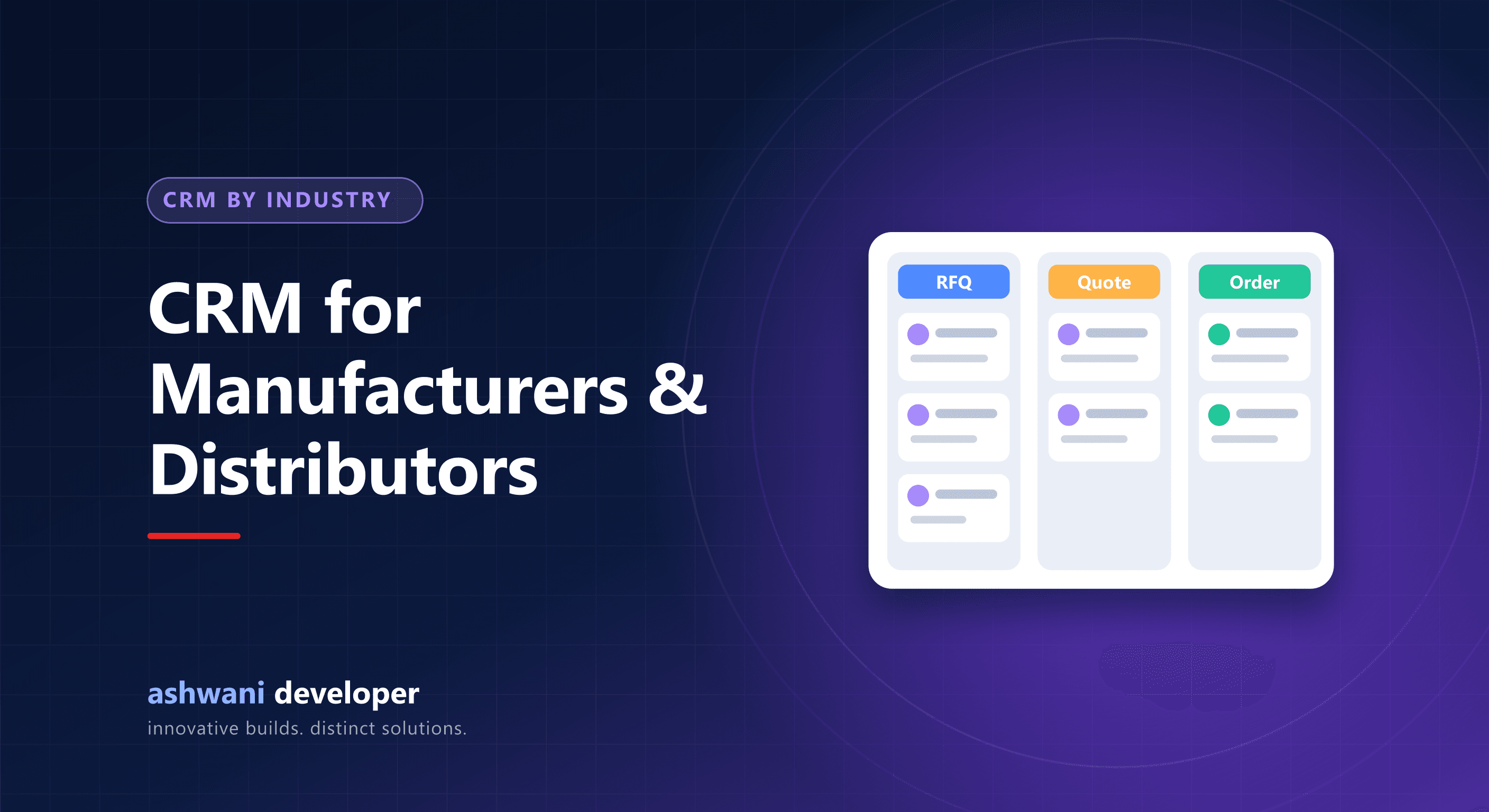
Quick answer: a manufacturing and distribution CRM tracks enquiries and RFQs, generates quotations, manages dealers and distributors, records field sales visits, converts orders into dispatch, and shows outstanding payments and sales by region, so management sees the whole sales chain in one place.
Manufacturers selling through dealers and distributors often run sales on phone calls, WhatsApp, and spreadsheets. Orders get missed, quotations vary by salesperson, and nobody knows which dealers are growing or slipping until month-end.
Core modules
Enquiries and RFQs
Capture enquiries from your website, trade portals, email, and exhibitions with product, quantity, and location. Assign them to the right sales engineer. See B2B websites for manufacturers for the front end.
Quotations
Generate consistent quotations from a product master with price lists, discounts within approval limits, taxes, and terms. Track versions and approval.
Dealer and distributor management
Dealer profiles, territories, credit limits, price lists, targets, schemes, and performance dashboards.
Orders and dispatch
Orders from salespeople or a dealer portal flow to dispatch with stock checks, then invoicing and delivery tracking.
Field sales
A mobile app for sales staff with beat plans, check-ins at dealer locations, visit notes, photos, and order taking, working offline where coverage is weak. See offline-first apps.
Payments and outstanding
Outstanding balances by dealer, ageing, reminders, and collection tracking, ideally synced with accounting.
Reports management actually uses
- Sales by product, region, salesperson, and dealer.
- Quotation-to-order conversion rate.
- Dealers with falling orders, for early intervention.
- Outstanding and overdue payments.
- Field visit coverage against beat plans.
Integrations
Connect with accounting or ERP for invoices and stock, WhatsApp for order confirmations and payment reminders, and your website for enquiries. See ERP vs CRM and inventory management.
Why custom often fits manufacturers
Pricing structures, schemes, approval chains, and dealer hierarchies vary a lot between manufacturers. A tailored system can model your exact process instead of forcing workarounds. Compare in custom CRM vs off-the-shelf SaaS.
Want visibility across your sales chain? See CRM and ERP development or describe your distribution model.